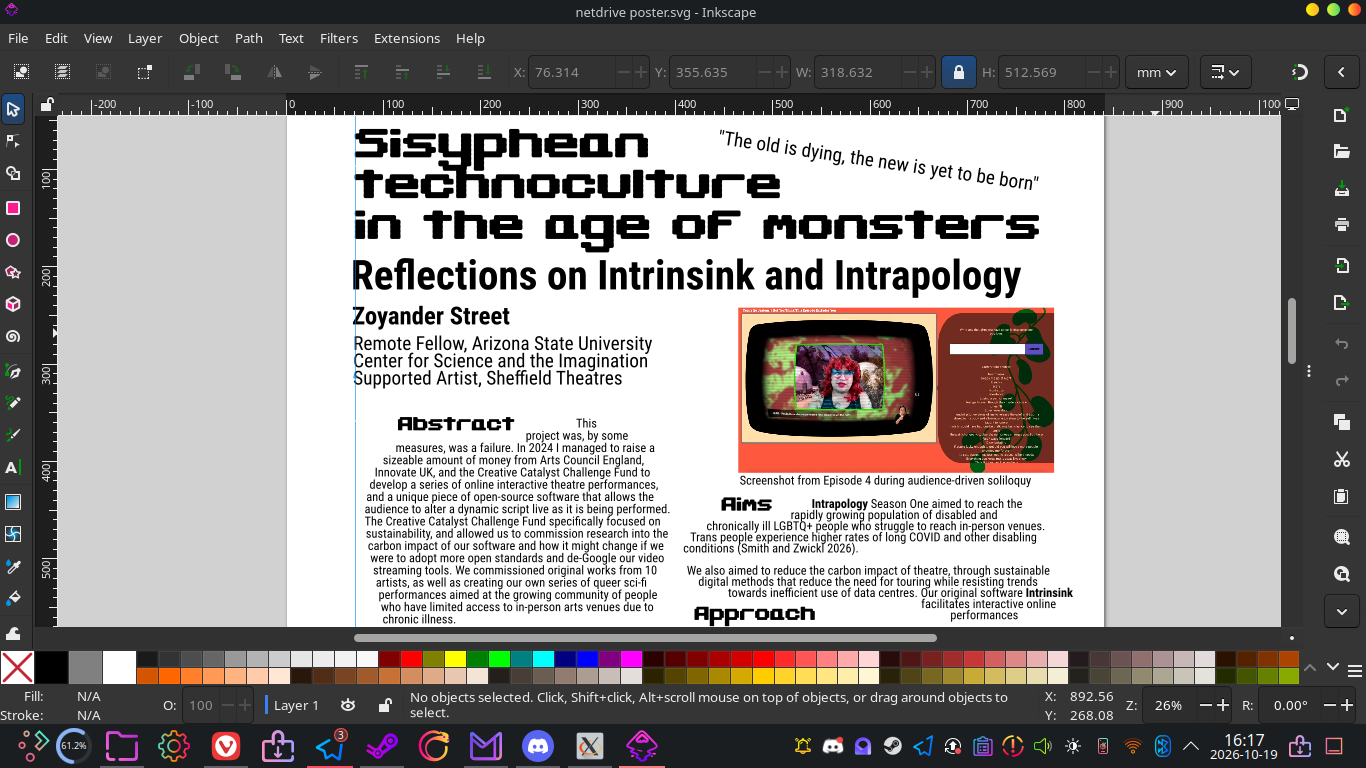
I’m currently preparing a poster to present at NetDRIVE, a hybrid online and in-person event at Watershed in Bristol on 4th - 6th November 2026.
The event aims to “galvanise collective action toward more sustainable digital research infrastructure.” I’ll be using Intrapology as an example, to address some of the barriers to collective action that we face due to algorithmically-mediated digital communications networks. In a way, disabled and trans communities are canaries in the coalmine for anyone who wants to communicate online about things that go against the interests of billionaires. This isn’t the internet of the 2010s anymore, but perhaps by acknowledging that we can build something better.
Tickets are free. More information is available on the NetDRIVE website.
Abstract
This project was, by some measures, was a failure. In 2024 I managed to raise a sizeable amount of money from Arts Council England, Innovate UK, and the Creative Catalyst Challenge Fund to develop a series of online interactive theatre performances, and a unique piece of open-source software that allows the audience to alter a dynamic script live as it is being performed. The Creative Catalyst Challenge Fund specifically focused on sustainability, and allowed us to commission research into the carbon impact of our software and how it might change if we were to adopt more open standards and de-Google our video streaming tools. We commissioned original works from 10 artists, as well as creating our own series of queer sci-fi performances aimed at the growing community of people who have limited access to in-person arts venues due to chronic illness.
Despite achieving many things that I’m proud of, I was left heartbroken by the difficulty reaching audiences. Our final performance was a hybrid in-person and online show in London that was selected for a festival of sci-fi theatre; only four people attended, one of whom stormed off as soon as trans rights were mentioned. Superficially, we were able to report positive audience engagement numbers to Arts Council England, but ticket sales across the project were a fraction of what I had predicted based on test performances in 2023. I’ve observed other artists in this space experiencing similar challenges.
I will argue that fostering sustainable technocultures requires collective effort through horizontal communication strategies. To foster a more sustainable internet, we must also address the hierarchical, profit-driven, individualistic cultures that have subverted its democratic potential, and build distribution networks that can cut through the noise.