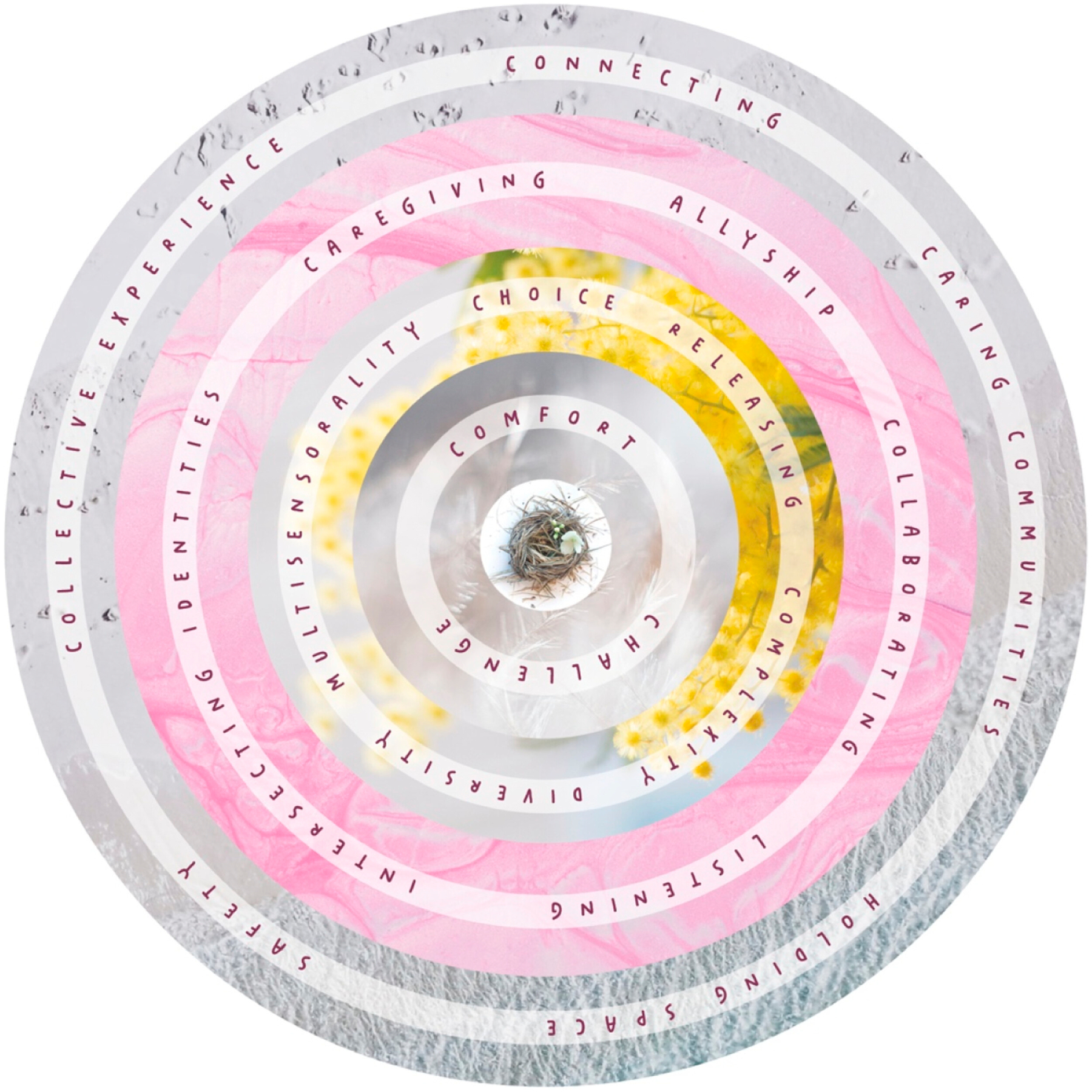
This was originally posted on our Patreon on January 22nd 2024. I’ve added some updated references in this repost, as well as audio narration. Image is ‘Layered principles, values and activities for creative, anti-oppressive and trauma aware practice’ collage from Sunderland et al. 2023
Content warning: mentions of medical gaslighting and suicidality
“Whatever being trans is about, it’s decidedly characterized by upheaval and emergence into a social world with shifting and shifted parameters. For many of us, surviving this process means committing to forms of healing that are unthinkable, indeed impossible, without care webs.”- Hil Malatino, Trans Care (access on Desperate Livin)
Among other things, Intrapology is a way of processing rage and a sense of abandonment as a queer disabled person. Everyone I Know Is Sick and we don’t know why. Why are almost all my queer friends chronically ill? Why are there so few doctors who understand our health needs? Why is the whole world acting like there’s no need to protect us from infection risks, despite the clear evidence that 10% of COVID infections results in long-term illness? (Edit: this figure now seems too low. A study in Japan published in 2026 found that 23% of infections led to long-term symptoms. A 2025 meta-analysis found the global prevalence of long COVID to be 36%) Shouldn’t we all be freaking out?
In 2021 an editorial in The Lancet recognised that “Many aspects of LGBTQI health and their determinants are woefully understudied” and that the majority of research in this area focuses on HIV and considers inequalities only from the perspective of risk behaviours. My lived experience both online and IRL tells me that there is a large intersection between LGBTQ+ identity, neurodiversity, and disability, but I struggle to find formal evidence to support this claim and communicate it to others. However, I do see evidence to support the following elements of it:
-
Trans people are more likely to be autistic, ADHD, etc., and the reverse is also true.
-
Neurodivergent people have unique health needs, and are more likely to acquire other disabling conditions.
-
Trans people experience minority stress that may increase susceptibility to acquired health issues, and face unequal treatment in the health sector. Trans people are considerably more likely to report that they do not feel listened to by doctors.
-
Some of the health issues that we tend to acquire make us more vulnerable to infections, and therefore more vulnerable to acquiring yet more chronic illnesses i.e. post-viral sequelae such as ME/CFS.
-
All of this is before even beginning to address the trauma held by the community due to the AIDS crisis, as well as high rates of medical trauma due to the power dynamics of transition-related care.
My lived experience also tells me that those of us who occupy these intersections have been let down by society in many ways, particularly after the easing of COVID-19 restrictions. This affects us in our workplaces, community spaces, and it shapes how we connect with arts and culture. A high % of disabled people do not access arts and culture as much as they would like - according to the National Disability Survey 2021, 47% of disabled people and 56% of carers. The UK Disability Arts Alliance 2021 Survey showed that almost two thirds of disabled CAH workers surveyed were worried they would have to leave the creative sector. 82% expressed concern about the continued provision of access for disabled audiences through reopening.
Our current situation demands a kind of art practice that centres mutual nourishing and collective flourishing. Poteat et al. in The Lancet call for more research not only into minority stress, but also into how LGBTQ+ people “cope and thrive” including “identity formation, access to social support, adaptive coping strategies, family formation, and healthy ageing”.
The experiences of the AIDS crisis and COVID-19 have demonstrated the ways that pandemics are socially and culturally embedded, forcing us to process intense uncertainty, inequity, and constantly evolving (mis)information. A 2019 report of the Canadian Standing Committee on Health on the health of 2SLGBTQIA people found that in general, we are more likely “to develop mental health disorders, have suicidal thoughts and attempt suicide” and that minority stress may “contribute to earlier onset of chronic diseases” in this community.
“anti-oppressive and trauma-aware creative arts practice can communicate complex information in a way that not only prioritises cultural and communication diversity, but also trauma-informed principles of nervous system regulation and cultural safety” - Sunderland et al. 2023
I feel drawn to make work that serves those of us at these intersections, and that addresses the need for a flourishing online arts and culture sector. It was briefly possible for us to access more arts and culture when events moved online during lockdown. The rush to return to normal has in some ways felt like an evacuation of the online sphere. This has been all the more disheartening because it is happening at the same time as a bunch of other profoundly depressing technoculture trends, such as so-called “AI” applications of large datasets that use other people’s work without consent and take a couple orders of magnitude more energy to complete than existing workflows.
Social media has been beneficial in many ways, but it also suffers from algorithmic bias, overwhelming commercialisation, and a transactional relationship with audiences. (Edit: I would now specify that corporate social media has these qualities. Community-owned alternatives such as the Fediverse do not have these problems.) This is demonstrated in everyday behaviours and comunication: advocates for marginalised communities are censoring their own use of language in order to avoid having their content suppressed by algorithms, and then finding that once in a while those same algorithms promote their work too far and put them in direct reach of people who are hostile towards them.
We cannot rely on recommendation algorithms to elevate work that challenges prevailing ways of seeing and being. This is part of why so many communities have moved into private spaces such as Discords and, indeed, Patreons. I am keen to hear about any structures that have emerged to connect these private communities, so that we can find one another.